Why Math Stops Being Fun in Middle School (And What Actually Helps)
It was a regular afternoon when my teenager walked in, flopped down, and said the thing that makes me absolutely crazy:
"I'm just bad at math."
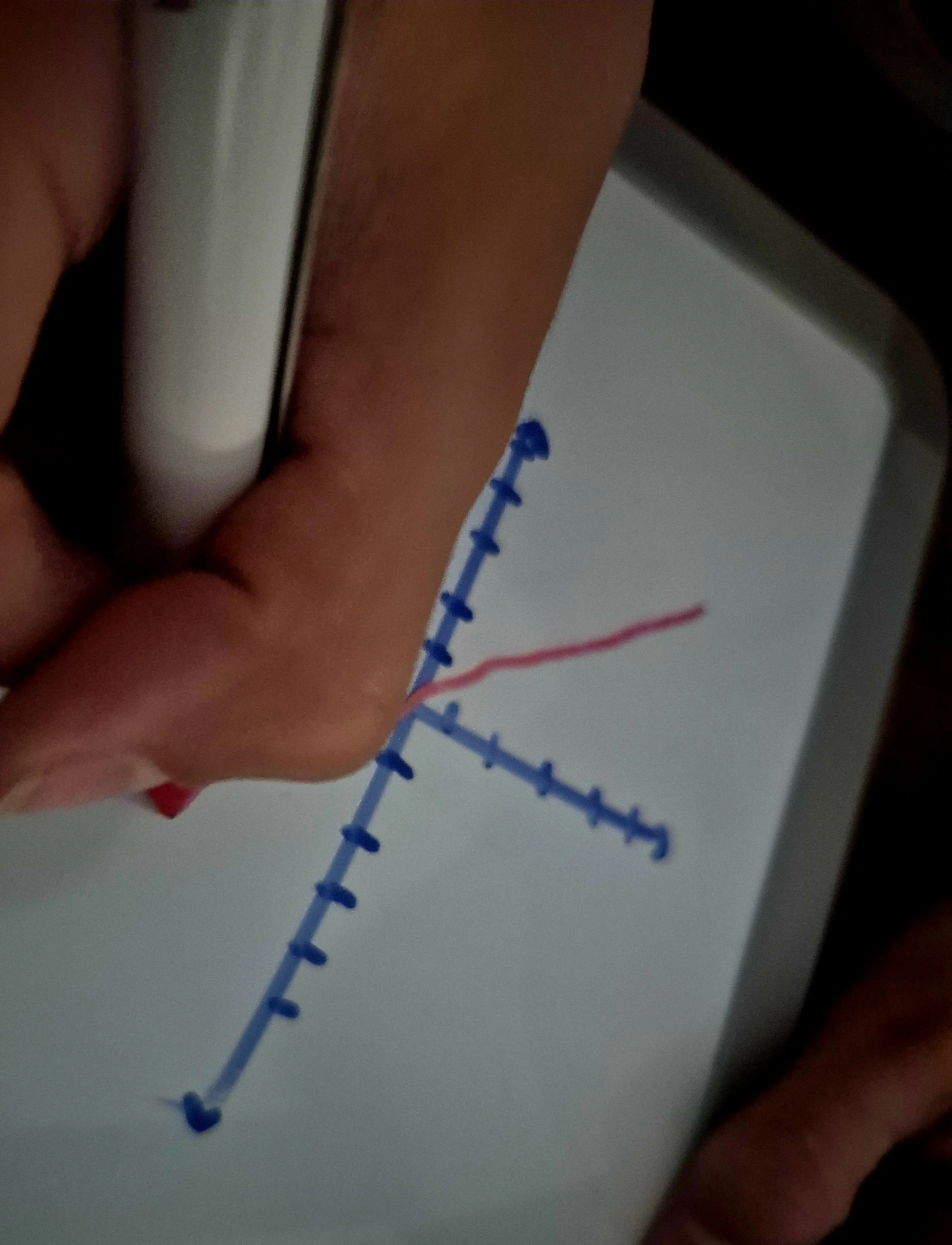
We were working on slope and y-intercept, finding it from a line on a graph. And she was making it so much harder than it needed to be, tying herself in knots trying to remember the steps, second-guessing everything, convinced she was missing some gene that makes math make sense.
So I put down the worksheet. I picked up a marker. And we just... drew the line.
Suddenly she could see it. She could see how the line moved, where it crossed, how each piece connected to the next. The confusion didn't disappear because I explained it better, it disappeared because she could finally see what she was building.
That moment is exactly why I think math stops being fun somewhere around middle school. And it's not because your kid isn't smart enough. It's because of how we teach it.
The foundation starts cracking
In the early years, math is pretty concrete. We count blocks. We cut up fraction bars. We draw pictures of problems. Kids can touch it, move it, see it and it makes sense.
Then middle school hits, and suddenly we're expected to look at an abstract equation and just get it. No blocks. No pictures. Just symbols on a page and an assumption that if you understood the simpler version, you'll figure out the harder one.
But here's the thing, if there are any shaky spots in the foundation, this is exactly where they show up. We move from basic operations and intro fractions into ratios, proportions, linear equations, and geometry, often without ever stopping to make sure the earlier stuff is truly solid. And when a kid doesn't have that strong base, everything starts to feel off balance. Like they're being asked to run before they've really nailed walking.
It's not a math problem. It's a sequencing problem.
We skip the concrete step
Even when we slow down and re-teach something, we often skip straight to the abstract. We show a picture in the textbook, or we describe what something looks like, and we expect that to be enough.
But that isn't how humans learn — not kids, not adults, not anyone.
Real understanding moves in a specific direction: first you need the concrete (touch it, draw it, build it), then you can move to a visual or representation, and only then does the abstract version click into place. Skip that first step and you get a kid who can maybe memorize the process but has no idea what she's actually doing or why.
That's what was happening with my daughter and that line. She'd been handed the abstract formula without ever getting to see the line as a real, physical thing she could reason about. Once we drew it, everything she already knew just snapped into place.
We try to do too much at once
Middle school math also has a habit of piling on. We introduce slope and y-intercept and graphing and writing equations all in the same week and then wonder why kids feel overwhelmed.
Confidence in math is built one layer at a time. You look at slope only: what is it, what does it mean, what does it look like on a line. You get comfortable there. Then you add the next thing. Then the next. Each piece gets its moment before it becomes part of a bigger picture.
When we rush that process, whether because of a curriculum schedule or a testing deadline or just the feeling that we should be further along, we accidentally teach kids that math is something you either get or you don't. That it's a talent, not a skill.
And that's where "I'm just bad at math" comes from.
What actually helps
The good news is that none of this is permanent. Math confidence can absolutely be rebuilt at any age, at any point in the year.
It starts with going back to concrete. Draw the line. Build the shape. Use manipulatives even if your kid is thirteen and thinks it's babyish. (Spoiler: once they see it working, they stop thinking it's babyish very fast.)
It means slowing down and spending real time with one concept before adding the next one.
And honestly? It helps enormously when math feels like something other than a performance. When there's room to be wrong, to try again, to laugh about it, the pressure drops and the thinking starts.
If you have a middle schooler who's hit that wall, who's started saying they're not a math person, or who's just going through the motions, I'd love for them to come play with us.
On April 20th I'm hosting a free live math class called Math Explorers, just for homeschool students in grades 5–8. We're going to spend an hour doing exactly what I described above: building understanding through games, concrete examples, and a whole lot of fun. No worksheets. No pressure. Just math the way it's supposed to feel.
Spots are limited and April 20th is coming up fast! I'd love to see your explorer there!
